Room guide
The room you will redecorate soonest.
Nursery art gets bought emotionally, in a hurry, before the baby arrives — and replaced about two years later. A little thought at the start buys several more years out of it.
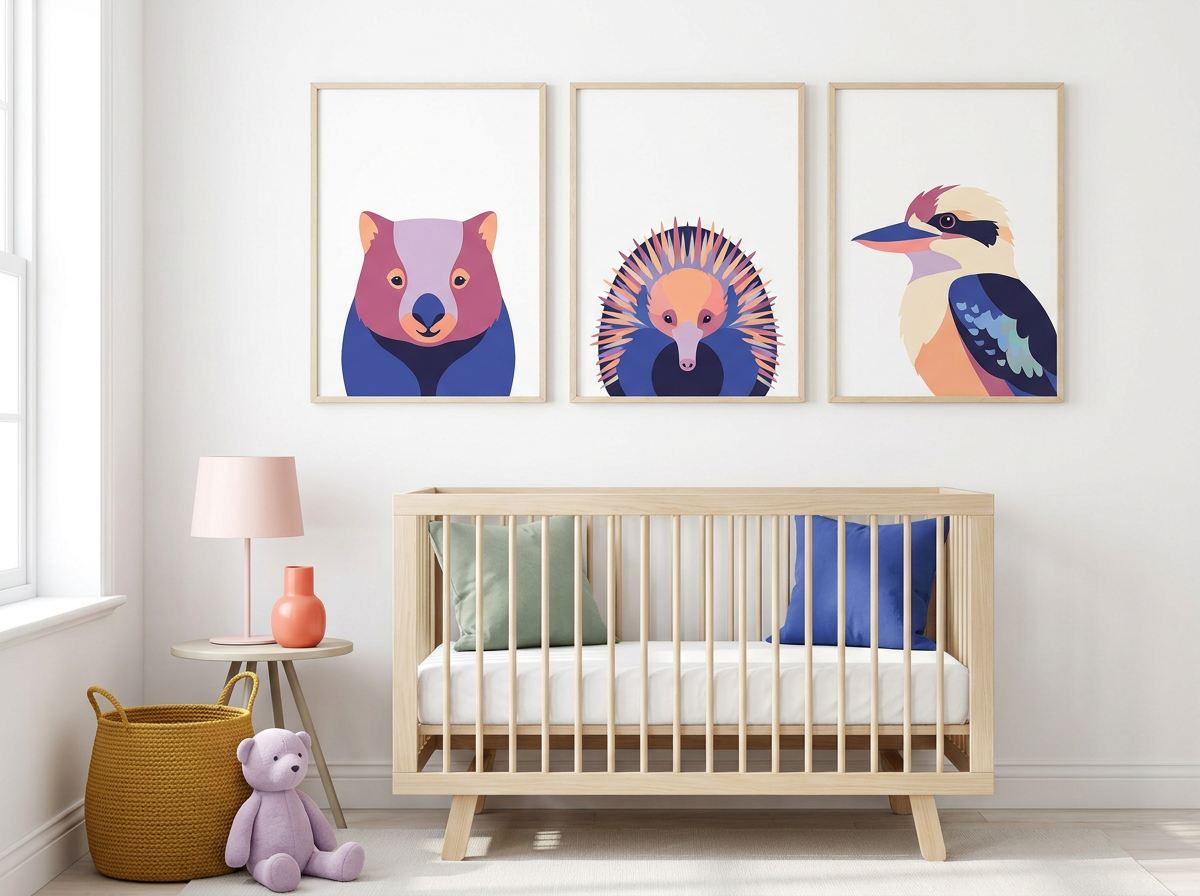
Safety, because this one genuinely matters
- Nothing framed in glass above the cot. Not lower-weight glass, not well-anchored glass. Use acrylic glazing, canvas, or an unframed print — or hang it on a different wall entirely.
- Keep it out of reach from inside the cot. A standing toddler has considerably more reach than you would guess, and anything reachable will eventually be pulled.
- Cords and hanging wire away from the cot. Same reasoning as blind cords.
The simplest answer is to treat the wall directly above the cot as unavailable and hang on the facing wall — which is the wall the child actually looks at anyway.
Hang it lower than you think
The 145 cm rule is set by adult eye level, and there are no adults lying in the cot. Art meant for the child to look at belongs considerably lower — around 90–110 cm. Art meant for the adult in the room at 3am stays at normal height. Decide which you are hanging.
Palette
Newborn vision handles high contrast far better than pastels for the first few months, which is the opposite of what nursery decor usually offers. But contrast is also stimulating, and a room for sleeping wants less of that. A reasonable compromise: soft, warm colours on the walls, and any high-contrast material kept to a book or a cot card that can be moved.
Choosing something that lasts
The art that gets replaced fastest is the art that is explicitly for a baby — cartoon animals, a name in nursery lettering, pastel clouds. It ages out with the cot. Work that lasts tends to be the same thing that works elsewhere in the house: simple shapes, a warm palette, a botanical or an abstract landscape. It suits a nursery now and a ten-year-old's room later, and you buy it once.
Match it to this room
Photograph the room and get a palette, a prompt in those colours, and a preview of how it looks once it is printed rather than lit.
Then work out the spacing
The planner turns your wall size and print sizes into exact nail positions.