Room guide
A room you see first thing, half awake.
Bedrooms are the one room where the art is looked at lying down, in low light, at either end of the day. That changes what works — and there is one practical point about hanging above a bed that most guides skip.
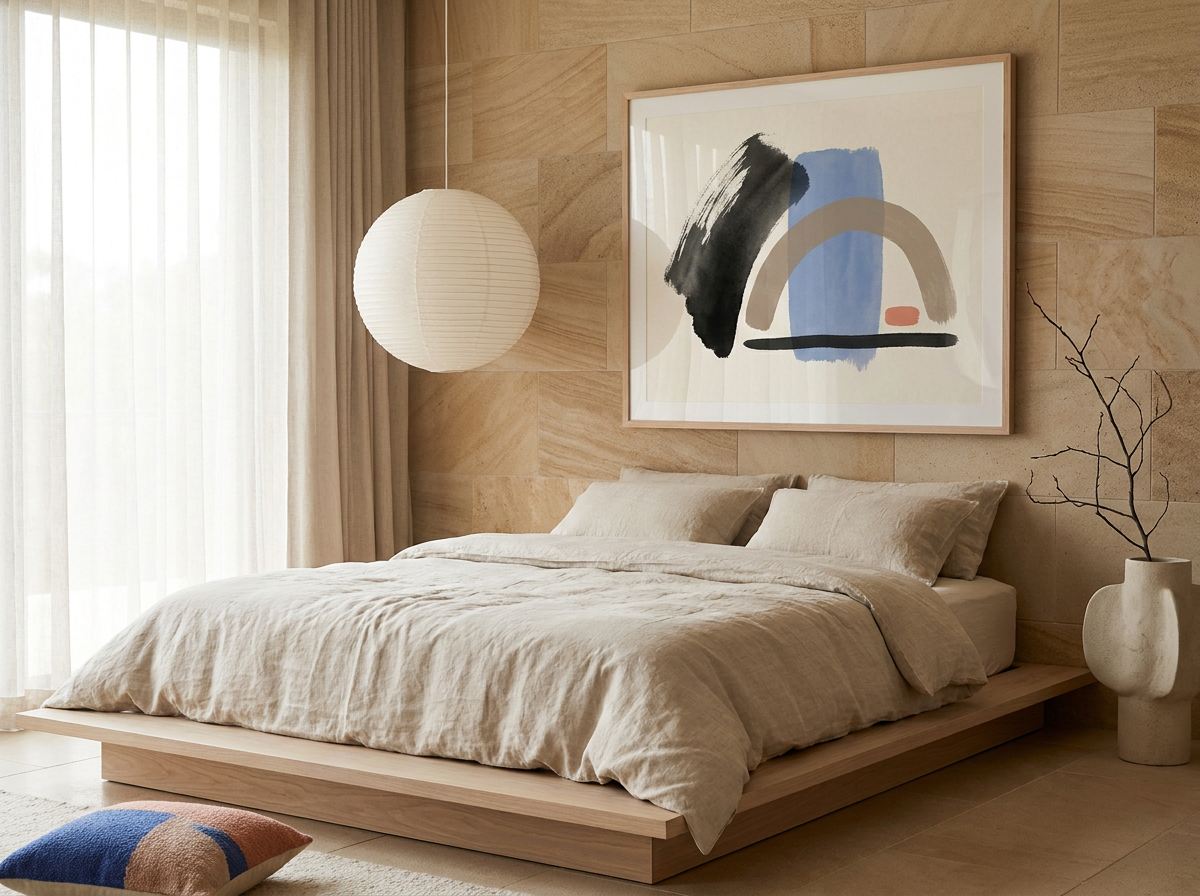
Above the bed: the practical bit first
Heavy framed glass above a bed head is worth thinking about properly. If you hang anything substantial there, fix it into a stud or use anchors rated well above the actual weight, and consider acrylic glazing rather than glass. This is the one wall in the house where a failure lands on someone asleep. It is not a reason to avoid hanging art above a bed — just a reason to hang it properly.
Size and height
The same two-thirds proportion applies: art spanning about two-thirds of the bed's width. A queen is 153 cm, so roughly 100 cm of art — a 50×70 pair, or one large landscape piece.
Leave 15–25 cm above the bed head. If your bed head is tall, measure from its top, not the mattress.
Why symmetry works here when it doesn't elsewhere
A bed is already a symmetrical object, centred on the wall with matching tables and lamps either side. An asymmetric arrangement above it fights that, and the room reads as slightly off without people knowing why. Bedrooms are the one place a matched pair or a centred single piece beats a casual salon hang.
Palette
Muted wins. Japandi and line art are the natural fits, and desaturated boho works where the room has texture. High-contrast, high-energy work is stimulating in a room whose purpose is the opposite — and in low evening light, saturated colour goes muddy anyway.
Match it to this room
Photograph the room and get a palette, a prompt in those colours, and a preview of how it looks once it is printed rather than lit.
Then work out the spacing
The planner turns your wall size and print sizes into exact nail positions.