Sets · Choosing
Why a set of three works, and how to pick one that does.
Sets of three are the default recommendation above a sofa for a reason that is purely arithmetic — and the reason most of them look wrong is a different one entirely.
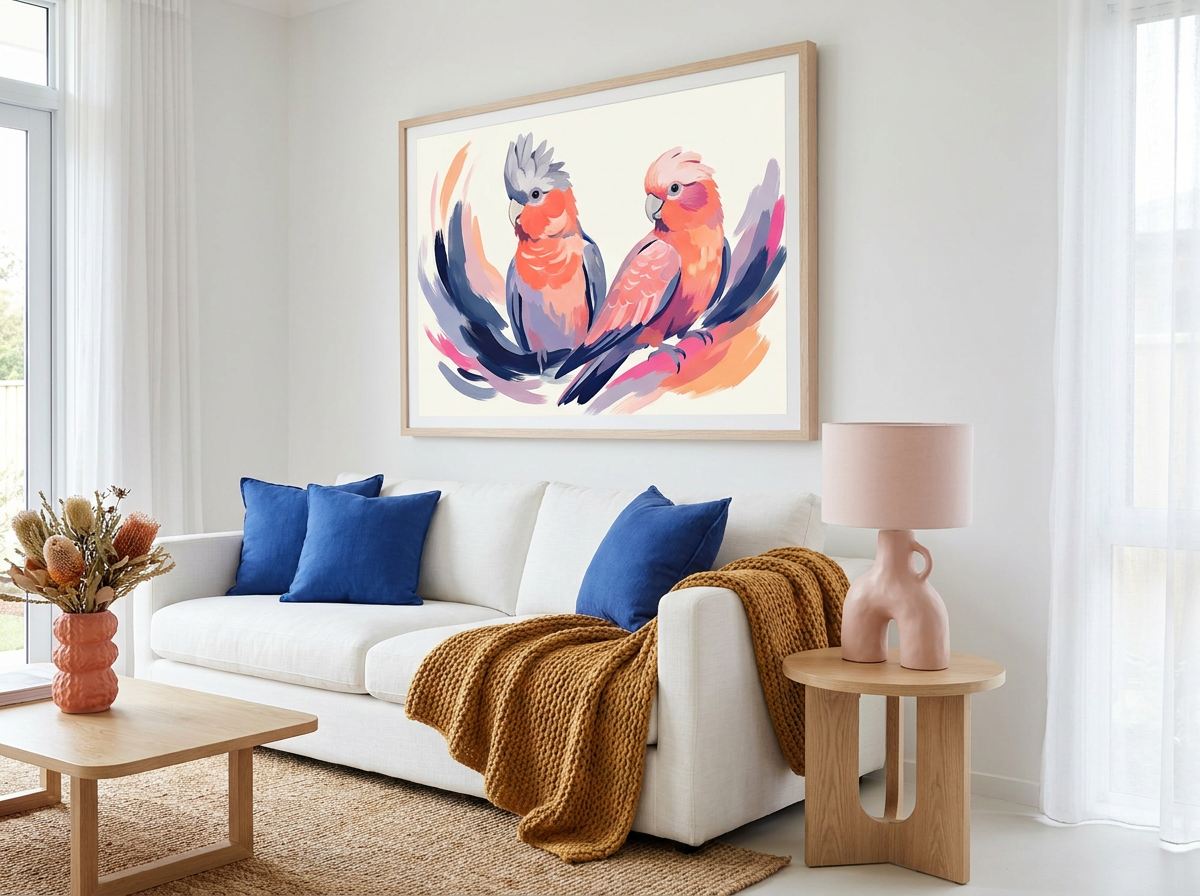
Arithmetic, not opinion. Every measurement below is either a standard paper size or a calculation, and the working is shown. Check it against your own wall before you drill.
The arithmetic reason
Art above a sofa should span about two-thirds of the sofa. A three-seater is roughly 210 cm, so the target is 140 cm.
One A2 gets you 42. One A1 landscape gets you 84. Three A2s with 7 cm gaps get you 140 exactly. There is no mystique in it: three is the number of standard prints that adds up to the right width at a size people can afford. Above a queen bed, where the target is around 102 cm, the same logic produces a pair.
The reason most sets look wrong
A set of three needs to read as one object from the doorway and as three when you walk up to it. That fails when the three pieces are merely on a similar theme. It works when they share a hard constraint:
- One palette, three compositions. The safest and the most forgiving.
- One composition, three colourways. Graphic and deliberate; needs the three colours to have similar weight or the group tilts.
- One subject, three views. Three studies of the same plant, three angles of the same coastline.
What does not work is three prints that happen to be the same size. Same size is not a constraint, it is a coincidence, and the wall shows it.
Order matters more than people expect
If the three pieces differ in visual weight — one darker, one busier — put the heaviest in the middle. The group then has a centre and reads as symmetrical even though the pieces differ. Heaviest at one end tips the whole arrangement and the eye keeps sliding off that side.
If all three carry equal weight, order barely matters. Try the one you like most on the left: in a language read left to right, that is where the eye starts.
Spacing
5 to 8 cm between frames, identical on both gaps. Anything wider and they become three separate prints that happen to be near each other; anything narrower and the frames crowd. Get the gap right and mismatched frames are forgivable. Get it wrong and matching frames won't save it.
Hanging three straight
Hang the middle one first, at its correct height, and get it truly level. Then measure the two outer ones from the middle piece rather than from the wall or from each other — errors measured from a neighbour accumulate along the row, errors measured from the centre don't. Run a strip of masking tape across the wall at nail height first.
What about four, or two?
Two is right for a queen bed and a narrow wall. Four in a row starts to look like a corridor unless the pieces are small, and is usually better as a 2×2 grid. Five in a row is fine for a long hallway seen from an angle, and rarely for anything else. Odd numbers get recommended out of habit; the width calculation is what actually decides it.
Full sizing tables are on the sizing page, and the other five arrangements are on gallery wall layouts.
Find a set in your room's colours
The matcher reads the palette out of a photo, then shows several compositions built on the same colours — which is exactly the constraint a set of three needs.
Now work out the spacing
Give it your wall width and the print sizes, and it returns the exact gaps and nail positions — no paper templates, no second set of holes.